
Transitional Kindergarten
For students turning 5 by
Ensuring children develop the skills for success in elementary school.

Program highlights

Language Immersion Setting
Students will be instructed in both French and Spanish alongside English.

Small cohort
The transitional kindergarten class is capped at 10 students with two teachers.
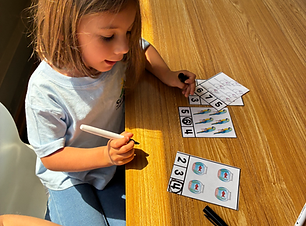
Intentional curriculum
Our program targets Idaho's early childhood learning domains that prepares students for elementary school.
Details
Schedule
8:45a-3:30p
Early drop-off from Le Soleil is offered per availability. All transitional kindergarten students get priority enrollment for Suntree's after-school program, which runs until 6:00p.
Curriculum
Play-based, student-led.
Idaho learning domains.
The transitional kindergarten curriculum continues Suntree's current preschool approach, and gains a more traditional structure as the year progresses, preparing them for elementary school.
Language Immersion Program
French
Spanish
The transitional kindergarten program implements both French and Spanish learning, with core concepts taught in English. No previous French or Spanish language experience is required—children pick up fast!
Our teachers come from all over the world.
We have a diverse, multicultural staff that helps teach the transitional kindergarten class about embracing and celebrating differences in background, experience, appearance, and ability. Staff members from all over the world help to form a team that leverages many different viewpoints to make the best experience possible for our students.

We believe in experiences, not screen time.
Aside from our optional once-a-month movie night, screen time at Suntree is not used except in sparing, pro-social activities, such as a student using our digital microscope to project small details of a found object on the wall. Research shows that learning in early childhood comes from engaging and interacting with the people, places, and objects around a child. Children need interpersonal interaction and big body movement for healthy development! That's why we're committed to providing a screen-free environment as part of our intentional environmental design, and it's why—despite the allure of its ease as a tool for busy, working families—we strongly recommend avoiding the use of screens like televisions, tablets, and phones at home, too. We, like you, want the very best for the children in our care.
We encourage healthy social and emotional development.
A part of this effort lies in the way that our staff praises children. Research has shown that using thoughtful praise can help a child to develop their ability to deal with challenges. Our staff is mindful of the language used in praise for children, and encourages effort rather than outcome. We use positive descriptive feedback rather than corrective feedback as much as possible. An interesting Ted Talk supporting this theory from child psychologist Carol Dweck is linked below.
The National Association for the Education of Young Children (NAEYC)
strongly endorses a play-based, hands-on approach to education for children from birth to eight years old. This position is supported by research and forms the core of our day-to-day activities at Suntree. Our goal is to help your young child begin to develop the skills to solve problems that will support them throughout their life.

Our curriculum is inspired by the early learning of Reggio Emilia, Italy,
a city that has created its own unique approach to early childhood education. There are a hundred different "languages" with which a child learns, and it is our job to use these many languages to engage them in learning. That means when we hold ateliers to learn creativity, we provoke children's reactions to nature and our wider community in order to find what interests them and how we can better model our curriculum each and every week to serve those interests. It's our goal to help children become citizens of the community, and we focus on building autonomy.
Family-friendly resources
Cognitive benefits of bilingualism
Harvard Graduate School of Education
Growth mindset TED Talk
Carol Dweck, child psychologist
Learning through play
National Association for the Education of Young Children
The Reggio Emilia approach
Scholastic